
gic26 north america menu call for proposals open
EventsBecome a Member
Sign In
da global logo
Opening Global Doors: Study Abroad Pathways for California Community College Students

Opening Global Doors: Study Abroad Pathways for California Community College Students

Opening Global Doors: Study Abroad Pathways for California Community College Students

world map passport banner

Community colleges enroll nearly half of all undergraduate students in the United States, yet they remain significantly underrepresented in study abroad participation. According to the Institute of International Education, only about 7% of U.S. study abroad participants in 2020–2021 (1)  came from community colleges.

This gap is a well-known issue that has existed for several decades, as reported by long-standing organizations (2). One participant indicated that institutions perpetuate this situation by solely focusing on the barriers that students might face. This deficit perspective limits how study abroad is presented, thus biasing students’ ability to even consider these opportunities.

As part of the DA Global Impact Fellowship, I conducted an environmental scan focused on study abroad resources available to California Community College students and the organizations that support them. The goal is to better understand the ecosystem and identify opportunities for community college professionals to collaborate and expand access for this student population.

What the Landscape Shows

While California is home to the largest community college system in the country, the ecosystem to support community college students is scattered at best, making it more difficult for students to navigate, access, and understand what is available to them. Conversations with partners and a review of available resources revealed several important patterns:

1. The pathway is underdeveloped

Many programs that welcome community college students do not clearly advertise this on their websites, making it harder for students and advisors to know where to begin.

2. The ecosystem is scattered

Multiple organizations support global learning in community colleges, but there is no single hub that aggregates their resources or opportunities.

3. Persistent deficit framing creates barriers

Institutions often focus on perceived obstacles (cost, preparation, and credit transfer) rather than the strengths and interests of community college learners and the career benefits global learning provides. This deficit perspective can unintentionally reduce enthusiasm and limit student engagement.

4. System-level planning rarely includes global learning

California’s Vision 2030 roadmap (3), for example, outlines ambitious goals for workforce and academic success but does not foreground global learning, despite the well-documented benefits for career readiness and intercultural development.

Opportunities for Practitioners Supporting Community College Students

This landscape scan highlights several areas where institutions, advisors, and practitioners can take action to improve access and visibility for community college learners:

1. Make community college students visible in your programming.

Ensure your study abroad materials, webpages, and outreach efforts clearly indicate whether two-year students are eligible and how they can participate.

2. Strengthen partnerships with organizations already serving this population.

Groups such as CCIE, CCID, and SAA offer existing models, resources, and networks that can support or expand community-college-focused global learning pathways.

3. Shift the narrative away from barriers.

Use strengths-based language when discussing global opportunities with students. Highlight their goals, lived experiences, and academic pathways rather than emphasizing obstacles.

4. Highlight flexible and varied program formats.

Short-term, faculty-led, COIL, and hybrid programs can be especially accessible for community college students balancing work, family, or transfer goals.

5. Engage colleagues across campus.

Connect with academic advisors, career services, TRIO staff, EOPS programs, and transfer centers to ensure global learning options are understood and visible throughout the institution.

6. Share examples and success stories.

Showcasing the experiences of community college alumni who studied abroad can help normalize participation and create relatable pathways for future students.

Looking Ahead

Expanding global learning opportunities for community college students requires planning and cross-campus collaboration. With nearly 2 million students in the California Community College system alone, this represents a large and diverse population with tremendous potential. Increasing visibility, strengthening partnerships, and reframing messaging can help ensure more community college students see global learning as possible and as a meaningful part of their academic journey.

California Townhall Abroad
California Colleges for International Education (CCIE)
California Community Colleges
Community Colleges for International Development
Institute of International Education
Study Abroad Association
True North Intercultural
Description
Provides general information on study abroad for CA students including those in community colleges
Non-profit consortia of California colleges, to assist faculty, staff, and students to address international education issues.

International association of community,technical, and vocational institutions to create globally learning environments.

Partnering with institutions to achieve internationalization goals. Promotes innovation in international education to increase access to global experiences

Offers capacity building to organizations interested in inter-cultural education
Notes

Membership based organization

Membership based organization

Includes global education platform with curated, interactive, multidisciplinary content to promote study abroad.

This is a resource for educators and/or organizations, not students

(1) Institute of International Education (2022). IIE Celebrates #CCMonth recognizing community colleges’ contributions to international education.

(2) Humphrys, J. and Koller, A (1994). The vision and the history. 1976-1994. Community Colleges for International Development Inc. 

(3) California Community Colleges (2023). Vision 2030. A roadmap for California Community Colleges. September 26, 2023. Retrieved from https://www.cccco.edu/-/media/CCCCO-Website/docs/report/Vision-2030-A-Roadmap-for-California-Com munity-Colleges.pdf 

This article is a part of an overarching project being developed by Dr. Alejandra Rincón as a part of her DA Global Impact Fellowship. Read the second contribution Promising Practices: Study Abroad Efforts in Two Northern California Community Colleges.

Alejandra Rincón

Alejandra Rincón, PhD is Assistant Vice-Chancellor at UCSF, advancing equity initiatives and teaching in medicine and leadership. She is an author, advocate, and board member. She is a 2025–2026 DA Global Impact Fellow. This resource was published on December 3, 2025. Learn more about Dr. Rincón.

From Insight to Impact: Why Sharing Your Work at Global Impact 2026 Matters

From Insight to Impact: Why Sharing Your Work at Global Impact 2026 Matters

From Insight to Impact: Why Sharing Your Work at Global Impact 2026 Matters

insight to impact header image

In a moment when higher education, workforce development, and global mobility are undergoing profound transitions, Global Impact reminds me of something essential: global learning has never been simply an academic enrichment opportunity. It’s a meaningful contributor to student success, career readiness, and institutional resilience. And at a time when so much is changing, we need spaces that invite collaboration, clarity, and vision across sectors.

That’s why the opening of the Call for Proposals for Global Impact 2026 – North America feels especially significant. Submitting a proposal isn’t just about getting on the program. It’s a chance to help shape where the field is headed.

Strengthening the Field Through Awareness: Why Submitting a Proposal Matters

Submitting a proposal is, at its heart, an act of leadership. It aligns with DA Global’s 4A Framework—Awareness, Access, Action, and Accountability—and helps move the field forward through shared understanding.

Preparing a session naturally begins with Awareness. It prompts you to pause and consider:

What challenges are students facing right now, and what does that reveal about how global learning influences their academic, professional, and personal trajectories?

As you unpack that question, the other “A’s” start to surface almost automatically:

  • Access grows when you share approaches, insights, or lessons that others might not otherwise encounter.
  • Action becomes possible when your session offers tools or strategies colleagues can implement on their own campuses.
  • Accountability shows up when we examine outcomes honestly and look at what worked, what didn’t, and what changed as a result.

Taken together, this process turns individual insight into shared progress. And while the 4A Framework is an institutional model, submitting a proposal is one of the most tangible ways practitioners bring it to life.

Advancing Opportunity & Impact: Benefits for Institutions and Individuals

Global Impact is known for showcasing innovation, but presenting offers much deeper value both for institutions and for professionals.

Institutional Benefits

When an institution’s staff or faculty present, it signals a commitment to connecting global learning with priorities such as:

  • student academic progress
  • career readiness and employability
  • inclusive access and opportunity
  • technology-enabled innovation
  • cross-unit collaboration
  • strategic partnership-building

Institutions gain visibility, attract collaborators, and contribute to shaping the future of global learning. Many also take ideas sparked at the conference back home, strengthening internal culture and practice long after the event ends.

Benefits for Individual Professionals

For practitioners, submitting a proposal can be a meaningful step forward in your professional journey. Presenting:

  • clarifies and strengthens your professional identity
  • increases your visibility across the field
  • expands your cross-sector network
  • opens doors to leadership opportunities, research projects, and collaboration
  • re-affirms the value of your work and perspective

The preparation process sharpens analytical thinking, and presenting amplifies those contributions to a global community.

Sector-Wide Impact: Building a Connected Global Learning Ecosystem

One of the clearest lessons from recent years is this: global learning doesn’t live in one office. It lives across the entire student experience.

Proposals rooted in cross-campus collaborations, from career services co-developing a session with international programs to student affairs presenting alongside faculty to, show what becomes possible when global learning is understood as shared work rather than a siloed responsibility.

And when we zoom out further, the ecosystem widens. Employers, nonprofits, government partners, and civic organizations all play a role in shaping the global competencies students need. Their perspectives help us understand:

  • workforce expectations
  • civic and social priorities
  • the evolving skills landscapes students must navigate

When these voices come together, the collective picture becomes richer and more actionable. In a world shaped by interconnected challenges, this kind of alignment isn’t optional—it’s essential.

A Collective Invitation to Shape Global Impact 2026

As we approach the Call for Proposals opening, I invite you to reflect on what you’ve learned this year through challenges, innovations, and unexpected moments of insight and use these moments as a base for your proposal.

  • What story do you have to share?
  • What practice or partnership has shifted outcomes for your students or your institution?
  • What idea could spark collaboration across campuses or industries?
  • How might your expertise help illuminate a path forward for the field?

Global education moves forward when we share what we know as well as when we learn from one another. Your voice, your experience, and your perspective matter.

Global Impact is more than a conference. It is a gathering of educators, practitioners, students, and partners committed to advancing global learning as a catalyst for student success, career readiness, and institutional strength.

This is where global education and student success meet.
I hope we’ll see your ideas in this year’s proposals.

Find out more about the Global Impact 2026 – North America call for proposals.

This blog post was written by Victoria Pope, Director of Operations, DA Global Access Network.

5 Things Every Career Professional Should Know About Global Education

5 Things Every Career Professional Should Know About Global Education

puzzle photo banner

This article is part of a DA Global series exploring the role of non-global education offices in championing global learning to advance student success, career readiness, and institutional impact.

Career services professionals are on the front lines of preparing students for success beyond graduation. Yet one area often overlooked in career conversations is global education, and its value as a key developer of the competencies employers value most.

Global experiences—whether study abroad, virtual internships, or international student engagement—are more than cultural enrichment. They help students build resilience, adapt to complexity, and collaborate across differences. These are not abstract benefits; they directly align with the NACE Career Readiness Competencies and the World Economic Forum’s (WEF) skills for 2030, including critical thinking and creativity, leadership, and digital fluency.

Global learning can be a powerful part of a student’s personal and professional growth. For career development professionals, the opportunity lies not only in recognizing the impact of global learning but also in equipping students to translate these experiences into compelling career narratives. But with already packed workloads and the need to stay abreast of developments in the early-career talent space, expecting career development professionals to also serve as gurus in global learning can be a tall order. That’s why we developed a quick list of five key insights about global learning that every career development professional can keep in their pocket. 

1. Global Learning Builds Transferable, Career-Ready Skills

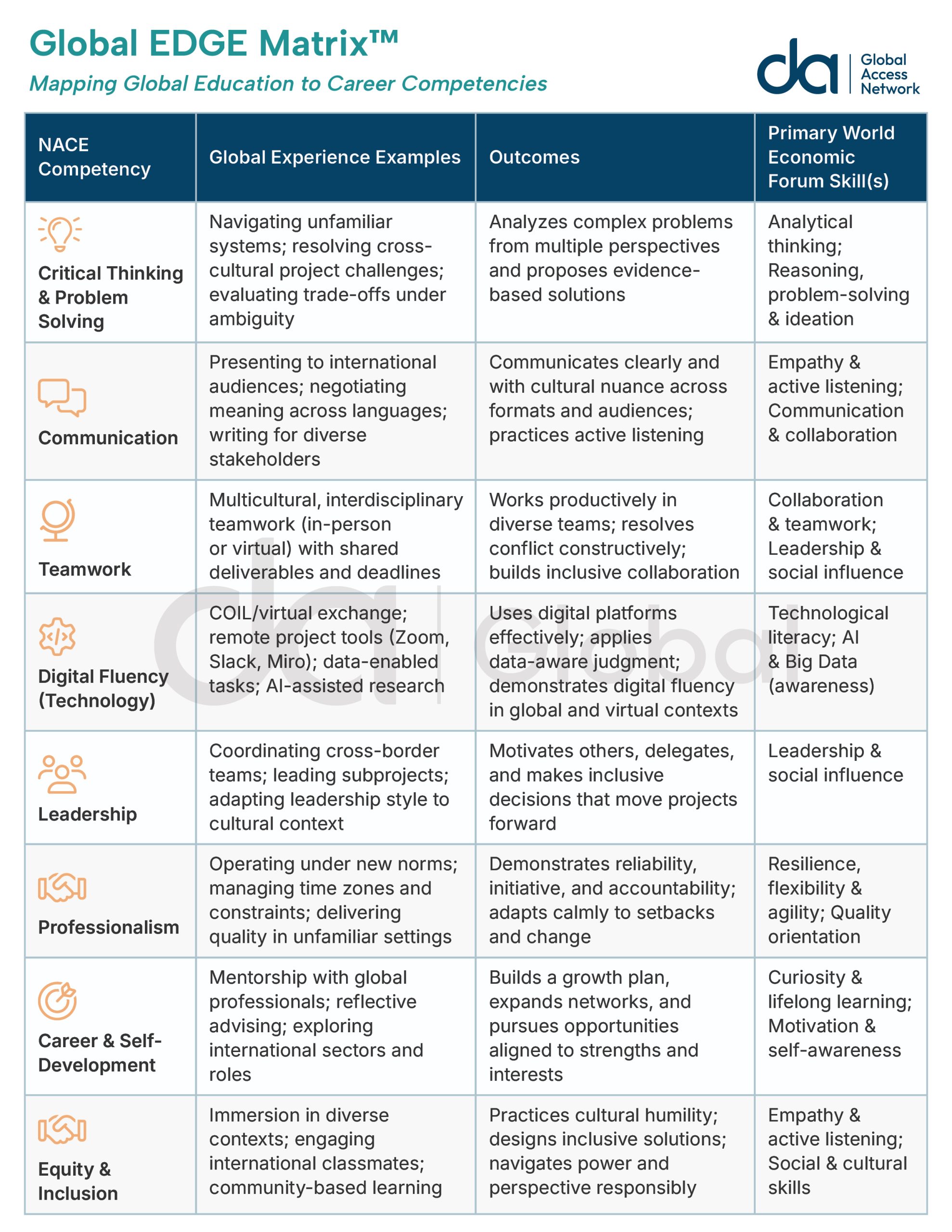
Global experiences often require students to navigate unfamiliar environments, work across linguistic or cultural differences, and solve problems in real time. For example, managing a group project in a foreign country, where cultural norms and communication styles differ, requires adaptability and strategic thinking. These are the very skills that NACE and the WEF identify as critical for success in a fast-changing job market. See the Global EDGE Matrix by DA Global, which maps global education to career competencies.  

Career professionals can help students connect the dots by asking questions like:

  • “What challenges did you face during your global experience, and how did you respond?”
  • “How did you collaborate with people from different cultural or professional backgrounds?”
  • “What did you learn about yourself in the process?”

By helping students reflect in this way, advisors can show them that global learning develops and strengthens employable skills across various fields and roles.

2. Cultural Agility Is Essential for Leadership

Employers consistently rank cultural competence among the top “soft skills” they seek in new hires. As workplaces grow more diverse and globally interconnected, the ability to collaborate across cultural, generational, and geographic boundaries is no longer optional—it’s foundational.

Global experiences provide students with real-world opportunities to develop cultural agility. Whether they are learning how different cultures approach teamwork or adjusting to varied communication norms, students develop the flexibility and empathy that effective leadership requires.

Instead of framing global learning only as personal enrichment, career professionals can highlight how these experiences contribute to leadership potential. For example, a student might say:

“Global education provides a powerful, proven way to develop critical competencies, but only if students (and their future employers) understand its value.”

“Global education provides a powerful, proven way to develop critical competencies, but only if students (and their future employers) understand its value.”

3. The Global Workplace Is Already Here

Many students will work with colleagues, clients, communities, or technologies that span borders. Some may work in hybrid or remote environments where cross-cultural collaboration is an everyday reality. Global learning mirrors these demands. This is true for students who participate in place-based programs, join a virtual international project team, or learn alongside international classmates on campus. In all cases, they are practicing skills that apply to contemporary workplaces and civic life.

Career practitioners can help students draw these parallels, which will not only prepare them for global roles but also position them to excel in hybrid and remote environments, where cultural understanding and digital fluency are critical.

4. Students Need Guidance to Translate Global Learning into Career Stories

One of the most common challenges students face after a global experience is articulating its impact. While they may feel transformed, they often struggle to explain that transformation in practical terms that resonate with employers.

For example, a student might return from a semester abroad and say, “I became more independent” or “I learned a lot about culture.” 

Through reflection and coaching, career professionals can help them take this further:


“I independently navigated complex transportation systems in a foreign language, which sharpened my problem-solving skills and taught me how to remain calm under pressure—skills I applied during my internship.”

Or

“Working across time zones and communication styles taught me to plan proactively and adapt my approach to meet shared goals.”

Supporting students in connecting global learning to career success starts when they are exploring which global experiences to pursue. Since participation in global experiences isn’t yet representative—especially for first-generation, low-income, and students of color—clear guidance on the career payoff of global experiences is critical. Workshopsparticularly in collaboration with global education offices—reflection exercises, and résumé coaching sessions that focus on “skills translation are crucial. Using global career success tools like BeGlobali also helps students articulate the impact of global learning. These strategies ensure that global education doesn’t remain just a line on a résumé but becomes a career-defining narrative.

5. Career Professionals Are Key Partners in Unlocking Global Competencies

Global education offices often focus on getting students “there and back,” but lack the capacity to support deep reflection and career integration post-program. Career services have an opportunity to play a vital role in making these experiences career-relevant. When these two offices collaborate, students gain clearer pathways to connect their learning to future goals. Possible points of partnership include:

  • Pre-departure sessions focused on personal and professional goals. 
  • Post-experience workshops or portfolio building. 
  • Employer-partner engagement to understand the value of global competencies during recruitment.
  • Learning together at conferences like Global Impact, which highlight concrete strategies for collaboration between career services and global education offices.

This cross-campus collaboration ensures that global experiences don’t sit in isolation but are integrated into the broader narrative of career readiness and success.

Why This Matters Now

The workforce is evolving rapidly, and students need more than technical expertise to succeed. Adaptability, communication, and cultural intelligence are now non-negotiable. Global education provides a powerful, proven way to develop these critical competencies, but only if students (and their future employers) understand its value.

Career professionals are in a powerful position to help students understand what they learned from global experiences and to communicate it with clarity and confidence.

Looking Ahead

These five insights represent just a starting point. In our white paper, Global Education as a Career Success Imperative, we explore how institutions can strategically embed global learning into career pathways, align it with NACE and WEF frameworks, and ensure equitable access for all students. The takeaway is simple: global education is workforce preparation. For career professionals, recognizing and communicating this link is one of the most impactful steps we can take to prepare students for the world they will inherit—and lead.