
This article is part of a DA Global series exploring the role of non-global education offices in championing global learning to advance student success, career readiness, and institutional impact.
Career services professionals are on the front lines of preparing students for success beyond graduation. Yet one area often overlooked in career conversations is global education, and its value as a key developer of the competencies employers value most.
Global experiences—whether study abroad, virtual internships, or international student engagement—are more than cultural enrichment. They help students build resilience, adapt to complexity, and collaborate across differences. These are not abstract benefits; they directly align with the NACE Career Readiness Competencies and the World Economic Forum’s (WEF) skills for 2030, including critical thinking and creativity, leadership, and digital fluency.
Global learning can be a powerful part of a student’s personal and professional growth. For career development professionals, the opportunity lies not only in recognizing the impact of global learning but also in equipping students to translate these experiences into compelling career narratives. But with already packed workloads and the need to stay abreast of developments in the early-career talent space, expecting career development professionals to also serve as gurus in global learning can be a tall order. That’s why we developed a quick list of five key insights about global learning that every career development professional can keep in their pocket.
1. Global Learning Builds Transferable, Career-Ready Skills
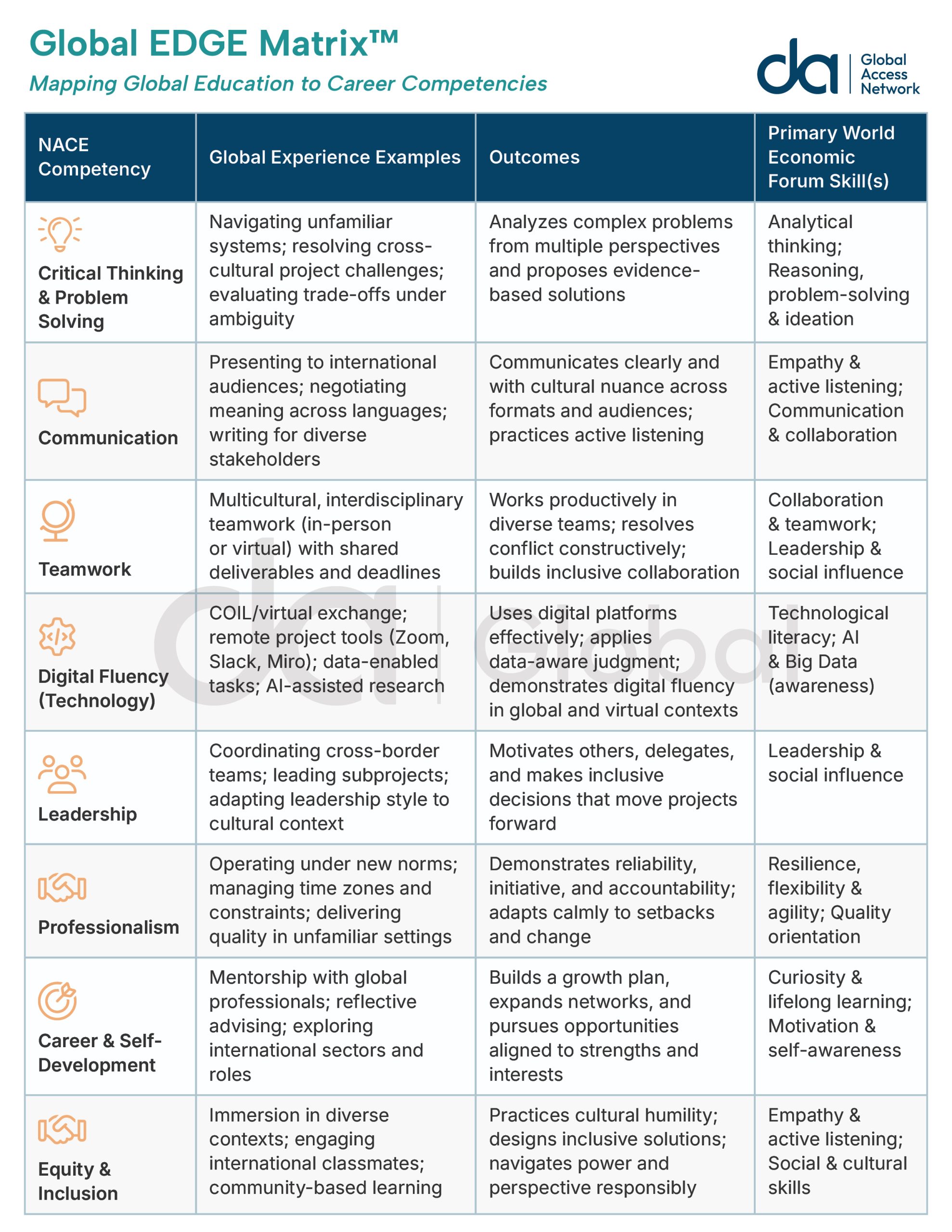
Global experiences often require students to navigate unfamiliar environments, work across linguistic or cultural differences, and solve problems in real time. For example, managing a group project in a foreign country, where cultural norms and communication styles differ, requires adaptability and strategic thinking. These are the very skills that NACE and the WEF identify as critical for success in a fast-changing job market. See the Global EDGE Matrix by DA Global, which maps global education to career competencies.
Career professionals can help students connect the dots by asking questions like:
- “What challenges did you face during your global experience, and how did you respond?”
- “How did you collaborate with people from different cultural or professional backgrounds?”
- “What did you learn about yourself in the process?”
By helping students reflect in this way, advisors can show them that global learning develops and strengthens employable skills across various fields and roles.
2. Cultural Agility Is Essential for Leadership
Employers consistently rank cultural competence among the top “soft skills” they seek in new hires. As workplaces grow more diverse and globally interconnected, the ability to collaborate across cultural, generational, and geographic boundaries is no longer optional—it’s foundational.
Global experiences provide students with real-world opportunities to develop cultural agility. Whether they are learning how different cultures approach teamwork or adjusting to varied communication norms, students develop the flexibility and empathy that effective leadership requires.
Instead of framing global learning only as personal enrichment, career professionals can highlight how these experiences contribute to leadership potential. For example, a student might say:
“Global education provides a powerful, proven way to develop critical competencies, but only if students (and their future employers) understand its value.”
“Global education provides a powerful, proven way to develop critical competencies, but only if students (and their future employers) understand its value.”
3. The Global Workplace Is Already Here
Many students will work with colleagues, clients, communities, or technologies that span borders. Some may work in hybrid or remote environments where cross-cultural collaboration is an everyday reality. Global learning mirrors these demands. This is true for students who participate in place-based programs, join a virtual international project team, or learn alongside international classmates on campus. In all cases, they are practicing skills that apply to contemporary workplaces and civic life.
Career practitioners can help students draw these parallels, which will not only prepare them for global roles but also position them to excel in hybrid and remote environments, where cultural understanding and digital fluency are critical.
4. Students Need Guidance to Translate Global Learning into Career Stories
One of the most common challenges students face after a global experience is articulating its impact. While they may feel transformed, they often struggle to explain that transformation in practical terms that resonate with employers.
For example, a student might return from a semester abroad and say, “I became more independent” or “I learned a lot about culture.”
Through reflection and coaching, career professionals can help them take this further:
“I independently navigated complex transportation systems in a foreign language, which sharpened my problem-solving skills and taught me how to remain calm under pressure—skills I applied during my internship.”
Or
“Working across time zones and communication styles taught me to plan proactively and adapt my approach to meet shared goals.”
Supporting students in connecting global learning to career success starts when they are exploring which global experiences to pursue. Since participation in global experiences isn’t yet representative—especially for first-generation, low-income, and students of color—clear guidance on the career payoff of global experiences is critical. Workshops—particularly in collaboration with global education offices—reflection exercises, and résumé coaching sessions that focus on “skills translation” are crucial. Using global career success tools like BeGlobali also helps students articulate the impact of global learning. These strategies ensure that global education doesn’t remain just a line on a résumé but becomes a career-defining narrative.
5. Career Professionals Are Key Partners in Unlocking Global Competencies
Global education offices often focus on getting students “there and back,” but lack the capacity to support deep reflection and career integration post-program. Career services have an opportunity to play a vital role in making these experiences career-relevant. When these two offices collaborate, students gain clearer pathways to connect their learning to future goals. Possible points of partnership include:
- Pre-departure sessions focused on personal and professional goals.
- Post-experience workshops or portfolio building.
- Employer-partner engagement to understand the value of global competencies during recruitment.
- Learning together at conferences like Global Impact, which highlight concrete strategies for collaboration between career services and global education offices.
This cross-campus collaboration ensures that global experiences don’t sit in isolation but are integrated into the broader narrative of career readiness and success.
Why This Matters Now
The workforce is evolving rapidly, and students need more than technical expertise to succeed. Adaptability, communication, and cultural intelligence are now non-negotiable. Global education provides a powerful, proven way to develop these critical competencies, but only if students (and their future employers) understand its value.
Career professionals are in a powerful position to help students understand what they learned from global experiences and to communicate it with clarity and confidence.
Looking Ahead
These five insights represent just a starting point. In our white paper, Global Education as a Career Success Imperative, we explore how institutions can strategically embed global learning into career pathways, align it with NACE and WEF frameworks, and ensure equitable access for all students. The takeaway is simple: global education is workforce preparation. For career professionals, recognizing and communicating this link is one of the most impactful steps we can take to prepare students for the world they will inherit—and lead.